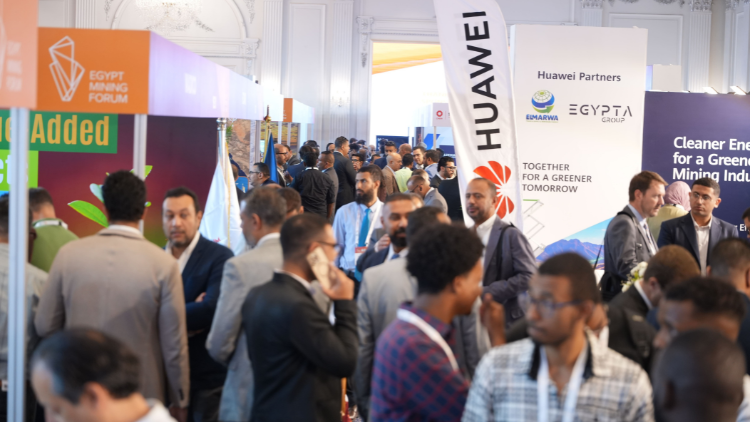
Egypt Mining Forum 2026 ended with a much broader message than “Egypt has minerals to explore.”
The fifth edition, held on 28-29 September in the New Capital, brought together more than 6,000 participants, investors, government officials and mining companies from around 50 countries. The government used the event to make the case that mining should become a much larger part of Egypt’s economy — and that the sector should move beyond simply extracting and exporting raw materials.
The ambition is significant. Egypt wants mining’s contribution to GDP to rise from less than 1% today to around 6%, while attracting more private investment, expanding exploration, processing more minerals locally and connecting mining more directly to manufacturing and exports.
The forum showed progress on several fronts: a new licensing model is attracting hundreds of bids, AngloGold Ashanti is preparing more investment around Sukari and new exploration areas, the World Bank is discussing financing and capacity building, and Egypt is pushing phosphate, manganese and other minerals further down the value chain.
But it also made clear what still has to happen.
Investor interest needs to turn into licenses. Licenses need to turn into exploration spending. Discoveries need to reach production. And production needs to support more processing and manufacturing inside Egypt.
Here are the biggest takeaways from Egypt Mining Forum 2026.
Egypt wants mining to become a real economic sector
The 6% GDP target is probably the clearest indication of how much larger the government wants the industry to become.
Mining currently contributes less than 1% of GDP, according to the Petroleum Ministry. Reaching around 6% would therefore require much more than incremental growth. It would mean a major expansion in exploration, mine development, processing, services and mineral-based manufacturing.
That explains why the government is increasingly treating mining as an industrial policy issue.
The goal is not only to discover more gold or phosphate.
It is to create an ecosystem around those discoveries: engineering, energy, transport, processing plants, equipment, services, manufacturing and exports.
That is a much larger economic opportunity than mining royalties alone.
The open-block system is already attracting interest
One of the most concrete numbers announced at the forum came from Egypt’s new Open Blocks System.
Launched in June, the system allows investors to apply for available mining blocks throughout the year rather than waiting for traditional periodic bid rounds. Once the first offer is received for a block, a 30-day competitive window begins.
During the first three months, 119 companies submitted 403 offers covering 118 exploration blocks, according to Petroleum Minister Karim Badawi.
More than 14 foreign companies participated, including firms from Australia, the UK, Canada, Saudi Arabia, Turkey, South Africa, India and China. The available areas include potential gold, phosphate, talc, kaolin and other mineral resources.
That is a strong signal of interest.
But it should not be confused with completed investment.
Offers on 118 blocks do not mean Egypt has already awarded 118 mining licenses or that all those areas will become mines. Licensing, exploration, geological results, financing and development still have to follow. The government itself is moving through the evaluation and allocation process. Pasted text
That distinction matters because mining projects can take years to move from exploration to commercial production.
Egypt is trying to make mining rules more competitive
Investor interest is partly being driven by changes to the regulatory and fiscal environment.
Egypt has been moving away from some of the older structures that investors considered difficult, while streamlining licensing and reorganizing the Mineral Resources Authority as a more commercially oriented economic authority.
The government has also said mineral-exploitation agreements can include tax and customs exemptions lasting up to 30 years, depending on the project.
The message to international mining companies is straightforward: Egypt wants to compete for long-term exploration capital.
This matters because mining companies have choices.
A company deciding where to spend exploration money can compare Egypt with countries across Africa, Latin America, Australia and elsewhere.
Good geology helps, but geology alone does not win investment.
Companies also compare taxes, royalties, licensing speed, access to geological data, infrastructure, political predictability and how quickly they can move money and equipment.
Egypt Mining Forum increasingly seems designed around addressing that full list.
The biggest shift is from raw minerals to processing
The strongest theme of the 2026 forum was not simply exploration.
It was value addition.
Industry Minister Khaled Hashem said Egypt wants to create integrated value chains connecting extraction, processing, refining and manufacturing.
The government is assessing locally extracted minerals to determine which can be processed into materials needed by Egyptian industry rather than exported in raw form.
This changes the economic calculation.
Exporting one tonne of raw mineral generates one level of value.
Processing it into a higher-grade industrial input can generate more.
Turning that processed material into fertilizer, chemicals, metals or manufactured components can generate even more.
That is where Egypt wants mining policy to move.
Phosphate is one of the clearest examples
Egypt has large phosphate resources, but the government increasingly wants the country to earn more from them before they leave the country.
The strategy is to limit dependence on raw phosphate exports and expand downstream products such as phosphoric acid and phosphate fertilizers.
This is already translating into industrial projects.
Eight downstream projects are being advanced, including the roughly $650 million Abu Tartour phosphoric acid complex, which is targeting annual output of around 250,000 tonnes from 2028. Pasted text
This is the type of project that shows what the new mining strategy actually means.
The value does not come only from extracting phosphate.
It comes from building processing industries around it.
Manganese could follow the same model
Manganese was another example highlighted at the forum.
Egyptian manganese can be used in steel and heavy industries, but the government wants more processing done domestically.
The Industry Ministry said it has already worked with two companies this year to process manganese ore locally into higher-concentration material.
The goal is to increase export value while also reducing imports of materials such as refractory products and silicon-manganese alloys.
Again, the economic logic is bigger than mining.
Local processing can support Egyptian steelmaking, manufacturing and industrial supply chains while reducing foreign-currency demand for imported inputs.
Metso is being brought in for technical expertise
Egypt also signed an MoU with Finnish mining technology company Metso during the forum.
The agreement covers technical and operational support for mineral processing and extraction projects, particularly iron ore and phosphate.
That includes laboratory analysis, feasibility studies, technical assessments, engineering consultancy and field expertise.
This is an important part of the value-chain strategy.
Processing minerals competitively requires technology and engineering expertise, not just mineral deposits.
Bringing global technology companies into the sector can help Egyptian firms improve recovery rates, product quality and operating efficiency while transferring technical knowledge locally.
The World Bank could help fill the financing gap
Mining is capital intensive long before it produces revenue.
Exploration companies can spend years drilling and testing before knowing whether they have a commercially viable deposit.
That creates a financing problem, especially for smaller companies and startups.
The World Bank discussions at the forum focused directly on this issue.
Badawi proposed cooperation in three areas: developing mining skills, supporting value-added projects in phosphate and fertilizers, and connecting early-stage mining companies with investors and financing.
The World Bank said it was interested in providing initial support and helping connect companies with suitable financial partners. The two sides are also working on a minerals roadmap assessing Egypt’s geological potential and what is needed to develop it.
This could matter almost as much as regulatory reform.
An exploration license has limited value if the company holding it cannot raise enough money to drill.
Sukari remains Egypt’s proof that large-scale mining can work
The Sukari Gold Mine remains the most important reference point for Egypt’s modern mining sector.
AngloGold Ashanti said it plans to invest around $400 million in Egypt in 2026, compared with roughly $250 million in 2025.
The company wants to raise Sukari production from around 500,000 ounces in 2025 to approximately 570,000 ounces within two years, while maintaining strong production for the next decade.
Sukari has produced more than 6.8 million ounces since production began and employs thousands of workers, the overwhelming majority of them Egyptian.
But the bigger signal is what AngloGold wants to do outside the existing mine.
AngloGold is looking beyond Sukari
AngloGold Ashanti has submitted bids for 19 new exploration blocks in Egypt.
The company sees the Eastern Desert as underexplored compared with major gold regions elsewhere in the world and intends to use technologies including satellite mapping, airborne geophysics and modern drilling methods in future exploration. This matters because Egypt needs a second generation of mining projects.
Sukari proves that a major mine can operate successfully.
But one large gold mine does not create a diversified mining industry.
The sector becomes more meaningful economically if Sukari leads to additional commercial discoveries, more operators and multiple mining districts.
That is why the results of the new exploration blocks will be watched closely.
Egypt wants foreign miners to build local supply chains too
President Abdel-Fattah El-Sisi’s talks with AngloGold Ashanti went beyond exploration.
The government wants international miners to contribute to technology transfer, workforce development and local supply chains.
That can create value even before a new mine reaches full production.
Large mines buy equipment, engineering services, transport, chemicals, maintenance, electricity, construction and professional services.
If more of those purchases come from Egyptian companies, mining’s economic impact becomes much larger.
The same logic has been used in Egypt’s oil, gas and renewable-energy sectors.
Mining is now moving in that direction too.
Energy is becoming part of the mining investment pitch
Mining and mineral processing consume large amounts of electricity.
That means Egypt’s ability to attract major projects partly depends on whether it can provide reliable and competitively priced power, including at remote sites.
Electricity Minister Mahmoud Esmat used the forum to address investor questions around energy supply.
The government says it is considering a mix of grid capacity, renewable energy and battery storage to serve energy-intensive and remote projects. Pasted text
This is particularly important for processing.
Egypt could discover valuable minerals, but downstream manufacturing will struggle if power costs or grid availability make processing uneconomic.
Mining policy and energy policy therefore increasingly have to move together.
Infrastructure could be one of Egypt’s biggest advantages
Egypt’s ports, roads, electricity network and Red Sea location featured repeatedly in discussions.
This is one area where the country may have an advantage over less developed mining jurisdictions.
A world-class mineral deposit located hundreds of kilometres from electricity, roads and export infrastructure can cost billions more to develop.
Egypt already has major transport and industrial infrastructure, particularly along the Red Sea and around established industrial zones.
The government wants to use that infrastructure to link extraction sites with processing plants and export corridors. Pasted text
That could also create an opportunity to process minerals sourced from elsewhere in Africa.
Egypt wants to process African minerals, not only its own
One of the more ambitious ideas discussed at the forum was positioning Egypt as a regional mineral-processing hub.
The logic is similar to Egypt’s strategy in natural gas.
Not every raw material processed in Egypt necessarily has to originate in Egypt.
Badawi said Egypt could potentially use its industrial and processing base to handle some minerals sourced from other African countries. Pasted text
That could create a regional business around refining, chemicals, fertilizers, metals and other mineral-based industries.
Egypt’s location between Africa, the Middle East and Europe strengthens the case.
But whether this becomes commercially viable will depend on logistics, trade agreements, power costs and the competitiveness of Egyptian processors.
African mining cooperation became a bigger part of the forum
Egypt also used the event to strengthen its regional role.
The African Minerals Regulatory Authorities Forum, or AFMRA, was launched in Cairo around the forum.
The initiative aims to improve cooperation among African mining regulators, share technical expertise, strengthen governance and gradually improve compatibility between regulatory systems while maintaining national sovereignty.
Participants also discussed better mineral traceability across African supply chains.
This matters because global buyers increasingly want to know where minerals originate and whether they meet environmental, social and governance standards.
Africa has enormous mineral resources.
The larger challenge is keeping more of the processing, manufacturing and economic value on the continent.
Egypt is looking beyond gold
Gold remains the most visible part of Egypt’s mining story because of Sukari.
But the 2026 forum made a deliberate effort to broaden the conversation.
Phosphate, manganese, copper, nickel, cobalt, talc, kaolin and other minerals featured in the investment discussion.
Critical minerals could become particularly important as global demand grows from electric vehicles, renewable energy, batteries and advanced manufacturing.
This diversification matters.
A mining sector built almost entirely around gold would have limited links to Egypt’s industrial strategy.
A sector supplying fertilizers, chemicals, metals and manufacturing inputs can have a much wider effect on the economy.
Skills are part of the strategy too
Mining development also creates a workforce challenge.
Modern exploration increasingly relies on geophysics, digital geological modelling, remote sensing and advanced drilling technology.
Processing requires metallurgical, chemical and engineering skills.
Egypt has therefore started investing more directly in specialist training, including establishing its first applied-technology school focused on mining in New Valley. Pasted text
International companies are also being encouraged to train Egyptian employees and transfer technical knowledge.
Sukari provides some evidence that localization is possible: Egyptian workers now make up the overwhelming majority of its workforce.
The forum generated interest. The next stage has to generate mines
This is the most important point.
Egypt Mining Forum 2026 produced large attendance numbers, hundreds of bids, international company interest and new partnerships.
That is useful.
But mining ultimately moves on a much slower timeline than conferences.
The Open Blocks bids still need to become awarded licenses.
Exploration companies need to raise capital.
Drilling needs to produce discoveries.
Discoveries need economically viable feasibility studies.
Projects need environmental approvals, infrastructure and financing.
Only then do mines get built.
That is why Prime Minister Mostafa Madbouly told investors after the forum that the government wants to shorten approval and project-development timelines and is prepared to consider incentives and even public-private investment structures to accelerate projects. Pasted text
The execution phase is now more important than the promotional phase.
What to watch after Egypt Mining Forum 2026
Several indicators will show whether the forum marked a real turning point.
The first is how many Open Blocks bids turn into formal exploration licenses.
The second is how much actual exploration capital reaches Egypt in 2027.
The third is whether AngloGold and other international miners make new commercial discoveries outside existing operations.
The fourth is whether projects such as Abu Tartour and other phosphate-processing investments reach construction and production on schedule.
The fifth is whether the World Bank and other financial institutions translate discussions into real financing.
And perhaps most importantly, watch how much of Egypt’s mineral output moves from raw export to domestic processing.
That will determine whether the mining strategy genuinely changes the structure of the economy.
The bottom line
Egypt Mining Forum 2026 showed that the country is no longer pitching mining simply as a search for the next Sukari.
The strategy is becoming much broader.
Egypt wants more exploration, but it also wants processing plants.
It wants international miners, but it also wants Egyptian suppliers and workers.
It wants to export minerals, but increasingly in higher-value forms.
And it wants its infrastructure to serve not only Egyptian resources but potentially a wider African mineral value chain.
The target of raising mining from less than 1% to around 6% of GDP is ambitious.
Whether Egypt gets anywhere close will depend less on the number of companies attending future forums and more on what happens after they leave: licenses issued, dollars invested, holes drilled, plants constructed and minerals processed locally.
That is the real scorecard for Egypt’s next mining phase.
Source: Egypt Business Directory



